



Hormone Replacement Causes Cancer, Right? Not Exactly…
“Fear of breast cancer is the strongest factor limiting postmenopausal hormone use.”
Source: JAMA. 2004;291(24):2947–2958.
Does hormone therapy cause cancer? The answer is more nuanced than a simple yes or no.
For decades, concerns about breast cancer, cardiovascular disease, and other potential complications have influenced how women and their healthcare providers approach menopausal hormone therapy. Much of this concern followed the publication of large studies, including the Women's Health Initiative (WHI) and the Million Women Study.
These studies contributed important information about the benefits and risks of hormone therapy. However, their findings have sometimes been generalized beyond the specific populations, hormone formulations, and treatment regimens investigated.
Subsequent research has helped clarify that the effects of hormone therapy depend on several factors, including the type of hormone used, whether estrogen is taken alone or with a progestogen, the route of administration, the duration of treatment, and the woman's age and time since menopause.
The key takeaway is that hormone therapy is not a single treatment with one uniform risk profile.Understanding the differences between hormone formulations and individual risk factors is essential when evaluating the evidence.
ESTROGEN, PROGESTERONE, AND BREAST CANCER RISK
One of the most important distinctions in menopausal hormone therapy research is the difference between estrogen-only therapy and combined estrogen-progestogen therapy.
In the Women's Health Initiative trials, the outcomes differed between women who had undergone hysterectomy and received conjugated equine estrogen alone and women who received conjugated equine estrogen combined with medroxyprogesterone acetate.
During long-term follow-up, the estrogen-only group had a lower incidence of breast cancer than the placebo group, whereas the combined-therapy group experienced an increased breast cancer risk. These findings apply to the specific regimens and populations studied and should not automatically be extrapolated to every hormone preparation.
A 2007 publication inBreast Cancer Research and Treatmentexamined differences in breast cancer risk associated with various hormone preparations:
“Estradiol and progesterone demonstrated no increased risk of breast cancer. Synthetic estrogen (Premarin®) and synthetic progestins (medroxyprogesterone and noresterone) all dramatically increased the risk of breast cancer.”
Source: Breast Cancer Research and Treatment. 2007;101:125–134.
These findings should be interpreted in the context of the study's design and the broader evidence. Research has suggested that different estrogen and progestogen formulations may have different risk profiles, but the evidence does not establish that estradiol combined with micronized progesterone is free of breast cancer risk.
For women considering hormone therapy, the distinction between estrogen-only treatment and combined treatment is particularly important. Women with an intact uterus generally need adequate progestogen protection when using systemic estrogen to reduce the risk of endometrial hyperplasia and uterine cancer.
WHAT DID THE DANISH OSTEOPOROSIS PREVENTION STUDY FIND?
The Danish Osteoporosis Prevention Study (DOPS) investigated the effects of hormone therapy in recently postmenopausal women.
The researchers reported:
“A significant reduction in risk of mortality, heart failure or myocardial infarction (heart attack) without any apparent increase in risk of cancer, venous thromboembolism, or stroke after the initiation of hormone replacement therapy.”
Read the study in theBritish Medical Journal.
These findings generated interest in the possibility that initiating hormone therapy closer to menopause may have a different benefit-risk profile from initiating it later in life.
However, DOPS had important limitations, including its open-label design and relatively small number of cardiovascular events. Its results do not establish that hormone therapy prevents cardiovascular disease or that cancer risks are absent across all treatment regimens.
The study is one part of a broader body of evidence supporting individualized decisions about menopausal hormone therapy.
IS ESTROGEN THE PRIMARY HORMONAL FACTOR IN BREAST CANCER?
Researchers continue to investigate the complex relationship between estrogen, progesterone, synthetic progestins, and breast cancer.
A 2024 article inAnnals of Oncologydiscussed the hypothesis that progestogens may contribute importantly to breast cancer risk in some hormone therapy regimens:
“There is a long-held notion that estrogen exposure will increase the risk for breast cancer. Conversely, a body of emerging clinical and basic research evidence suggests that progestogens (synthetic or endogenous progesterone) are most likely the primary hormonal factor underlying seemingly estrogen-associated breast cancer risk.”
Read the article inAnnals of Oncology.
This represents a particular interpretation of the evidence rather than a settled scientific consensus. Estrogen and progestogens have different biological effects, and their relationship to breast cancer is complex. Research findings also vary according to the hormone formulation, treatment duration, and population studied.
It is therefore important not to assume that all progestogens carry the same risk or that estrogen is universally safe. The available evidence supports evaluating individual hormone regimens rather than treating all hormone therapies as equivalent.
REVISITING THE WOMEN'S HEALTH INITIATIVE
The Women's Health Initiative changed the public conversation about hormone therapy when its initial findings were published in the early 2000s.
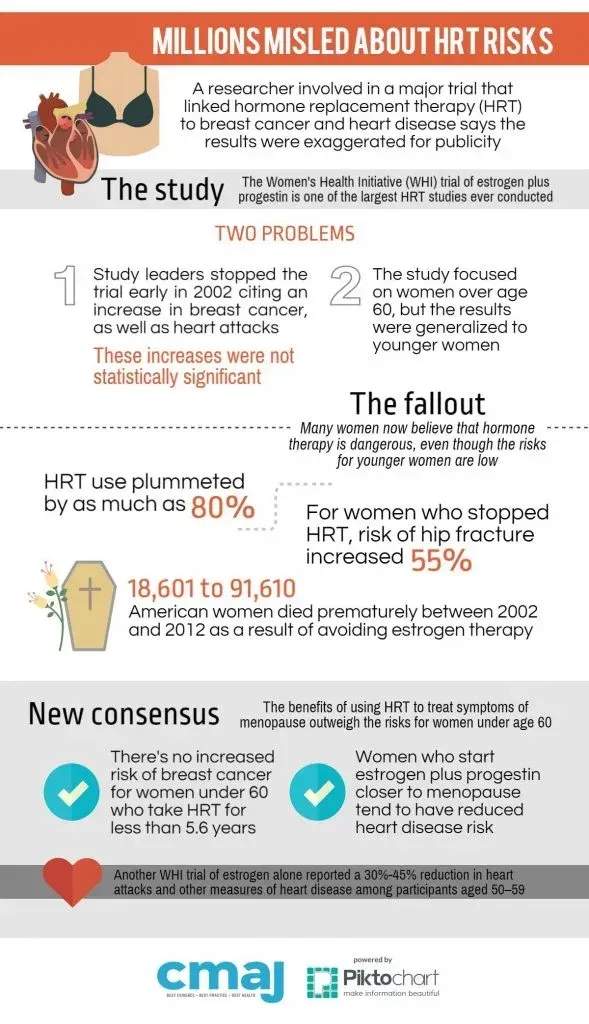
Subsequent analyses have emphasized that the age of participants and the timing of treatment initiation are important when interpreting the results. The average participant in the major WHI hormone trials was approximately 63 years old, and the findings from those trials cannot be applied identically to every woman beginning treatment around the time of menopause.
A 2017 article in theCanadian Medical Association Journalexplored the continuing debate about the interpretation and communication of the WHI findings:
“A principal investigator of a landmark women's health study says initial results that linked hormone replacement therapy (HRT) to breast cancer and heart attacks were misleading and distorted for publicity. Others involved in the study claim the findings were merely misunderstood. Fifteen years on, a new consensus about risks and benefits is emerging, but too late for a generation of women who abandoned or avoided HRT due to reported risks.”
Read the CMAJ article.
The debate illustrates how difficult it can be to communicate complex medical findings to the public. Although subsequent analyses have refined our understanding of hormone therapy, the original WHI findings remain important and should not be dismissed.
For many healthy women younger than 60 or within 10 years of menopause onset who have no contraindications, the benefit-risk balance of hormone therapy is generally more favorable when treatment is used for appropriate indications, such as bothersome menopausal symptoms or prevention of bone loss.
However, hormone therapy is not recommended solely to prevent cardiovascular disease or other chronic conditions in otherwise asymptomatic postmenopausal women. The U.S. Preventive Services Task Force has concluded that systemic hormone therapy offers no net benefit for primary prevention of chronic conditions in this population.
Read the USPSTF recommendation on menopausal hormone therapy.
DID AVOIDING ESTROGEN CAUSE PREMATURE DEATHS?
One controversial analysis estimated that many women may have experienced adverse health outcomes following the widespread avoidance of estrogen therapy after the initial WHI findings.
The authors reported:
“Over a 10-year span, starting in 2002, a minimum of 18,601 and as many as 91,610 postmenopausal women died prematurely because of the avoidance of estrogen therapy.”
Read the published analysis on estrogen therapy and mortality.
This estimate reflects a researcher's analysis of the potential consequences of changes in hormone therapy use. It is not a directly measured count of deaths proven to have resulted from avoiding estrogen, and the estimate remains subject to the assumptions and limitations of the analysis.
Nevertheless, it raises an important question: Could an overly generalized fear of hormone therapy have discouraged some women who might otherwise have benefited from appropriate treatment?
The answer is that hormone therapy decisions should be individualized. Both the potential harms of treatment and the consequences of leaving symptoms or certain medical conditions untreated deserve consideration.
ESTROGEN AND CARDIOVASCULAR HEALTH
Cardiovascular disease is a leading cause of death among women, and estrogen influences multiple processes involved in vascular function and metabolism.
However, the relationship between estrogen and cardiovascular disease is complex. Although some observational studies have suggested cardiovascular benefits associated with hormone therapy, randomized clinical trials have not established systemic menopausal hormone therapy as a treatment for primary prevention of cardiovascular disease.
One frequently cited publication examined the role of estrogen in cardiovascular health:
Read the research on estrogen and cardiovascular disease.
The broader evidence supports a more individualized approach than either assuming estrogen is protective against heart disease or concluding that it should always be avoided.
The timing of treatment, the hormone formulation, the route of administration, and the patient's underlying cardiovascular risk all matter. Established cardiovascular prevention strategies, including blood pressure management, lipid management, physical activity, and smoking cessation, remain essential regardless of whether hormone therapy is used.
WHAT DOES THE EVIDENCE SUGGEST?
A 2024 article inAnnals of Oncologysummarized one interpretation of the available research:
“Overall, current scientific evidence suggests that estrogen therapy, coupled with minimal use of a progestogen, is likely to offer net health benefits in women in need of HRT.”
Read the full article inAnnals of Oncology.
This conclusion represents the authors' interpretation and should not be taken as a universal recommendation. In women with an intact uterus, adequate progestogen is necessary to protect the endometrium when systemic estrogen is prescribed. The appropriate regimen depends on the patient's circumstances, and the potential benefits and risks must be evaluated individually.
The National Cancer Institute's review of menopausal hormone therapy provides a useful overview of the evidence regarding different formulations and cancer outcomes:
Read the National Cancer Institute's review of menopausal hormone therapy and cancer.
WHAT SHOULD YOU DO NEXT?
The question is not simply whether hormone replacement causes cancer. A more useful question is:Which hormone, in which formulation, for which patient, at what dose, and for how long?
Hormone therapy can provide substantial benefits for appropriately selected patients, particularly for the management of menopausal symptoms and the prevention of bone loss in certain circumstances. At the same time, some regimens are associated with increased risks of breast cancer, blood clots, stroke, or other adverse outcomes.
If you are considering hormone therapy, seek a qualified healthcare professional who can discuss the evidence, assess your medical history and individual risk factors, and develop an appropriate treatment and monitoring plan.
At Valley Integrative Health, our goal is to help patients understand their options and make informed decisions about their health through an individualized, patient-centered approach.
CONTACT VALLEY INTEGRATIVE HEALTH TODAY
Devin Wilson, ND, is a licensed Naturopathic Doctor and owner of Valley Integrative Health, LLC, in Ashland, Oregon. With over a decade of clinical experience, including two years of training with a physician affiliated with Johns Hopkins and Yale, Dr. Wilson integrates naturopathic and modern medical approaches with selected advanced therapies. He has completed advanced training in anti-aging medicine and bioidentical hormone therapy through the American Academy of Anti-Aging Medicine (A4M). Dr. Wilson has also previously worked at a specialized stem cell and anti-aging clinic. His goal is to help patients re-establish, maintain, and optimize their health through an individualized, patient-centered approach.